
Introduction to Ethernet If you’ve ever plugged a cable into...
Read MoreEnterprise Routing
Enterprise routing forms the backbone of modern corporate networks, enabling efficient data packet forwarding between LANs, WANs, data centers, and the internet. This pillar covers everything from basic routing tables and static routes to dynamic protocols like OSPF, EIGRP, and BGP, plus advanced scaling, redundancy, and troubleshooting. Whether you’re configuring your first router or optimizing a multi-site enterprise environment, start here to build strong Layer 3 foundations.
Introduction
Enterprize Routing for Beginners
Master the essentials first
If you’re new to routing or refreshing core concepts, begin here. These foundational topics explain how routers make forwarding decisions, handle IP packets, and connect different networks without overwhelming complexity.
- Routing Table Fundamentals – How routers decide where to send packets
- Static Routing Basics – Manual route configuration for simple networks
- Default Routes & Gateway of Last Resort – Sending unknown traffic efficiently
- Connected Routes & Administrative Distance – Understanding route priority
- IP Addressing & Subnetting Review – Critical for any routing design
- Dynamic vs Static Routing – When to use each approach
- Basic Router Configuration (show ip route, ping, traceroute) – Essential verification commands
Intermediate Path
Build Scalable & Reliable Designs
Move beyond basics to protocols that power real enterprise networks. Learn link-state and distance-vector behaviors, neighbor relationships, and redundancy mechanisms used in mid-sized to large deployments.
- OSPF Basics – Areas, LSAs, and single-area design
- OSPF Neighbor States & Adjacency Formation – Troubleshooting connectivity
- EIGRP Fundamentals – DUAL algorithm and path selection
- HSRP / VRRP / GLBP – First-hop redundancy protocols
- Route Redistribution Basics – Sharing routes between protocols
- Passive Interfaces & Default-Information Originate – Control route advertisement
- Summarization & Stub Areas – Reduce routing table size
Advanced Path
Enterprise-Scale Routing Mastery
For architects and senior engineers: Dive into external routing, policy control, large-scale convergence, and MPLS/VPN integration used in global enterprises.
- BGP Basics – eBGP & iBGP, path attributes, and route selection
- BGP Route Reflectors & Confederations – Scaling iBGP without full mesh
- OSPF Scaling – Multi-area designs, virtual links, and LSA filtering
- IS-IS vs OSPF in Enterprise – When to choose link-state alternatives
- MPLS L3VPN Explained – Label switching and VPNv4 routing
- Route Filtering & Policies (prefix-lists, route-maps) – Secure and control routing
- Advanced Convergence Techniques – BFD, tuning timers
Common Problems & Fast Fixes
Routing Loops
Symptoms: Packets circling endlessly
OSPF Adjacency Failures
No neighbor formed → Fix: Verify MTU match, hello/dead timers, area types, authentication.
BGP Routes Present but No Traffic
Best path selected but blackholed → Fix: Check next-hop reachability, recursive lookup, IGP sync issues.
MTU/MSS Issues & Fragmentation
Packet drops on tunnels/VPNs → Fix: Set consistent MTU, enable path MTU discovery.
Asymmetric Routing
Return path different → Fix: Ensure symmetric design or use policy-based routing.
Suboptimal Routing / High Latency
Packets taking long paths → Fix: Tune metrics, use traffic engineering, verify route preferences.
High CPU on Routers
Control-plane overload → Fix: Rate-limit, CoPP, summarize routes.
Tools & Platforms Enterprises Use
Introduction to Spanning Tree Protocol (STP)
Switches are simple devices at heart — they forward frames...
Read More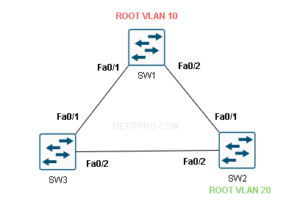
Frequently Asked Questions
What is the difference between a router and a switch?
Switches forward based on MAC (Layer 2); routers forward based on IP (Layer 3) and connect different networks.
When should I use static routing vs dynamic routing?
Static for small/simple networks or default routes; dynamic (OSPF/BGP) for scalability and automatic failover in enterprises.
What is Administrative Distance (AD)?
AD ranks route sources (connected=0, static=1, eBGP=20, OSPF=110, iBGP=200); lower wins.
Why does BGP use TCP port 179?
For reliable transport of routing updates between peers.
What causes routing blackholes?
Often next-hop unreachable, recursive lookup failure, or policy misconfiguration.
How do I prevent routing loops in redistribution?
Use route filters, tags, or distribute-lists to block re-advertised routes.